 Trusted domain applicability Trusted domain applicability
|
This article is only applicable to M33-TD flavor  of STM32MP2 series of STM32MP2 series
|
This article lists all internal peripherals embedded in STM32MP23x lines  and shows the assignment possibilities to the execution contexts for each one of them.
From this article, you can also access to individual peripheral articles with information related to the overview and configuration aspects.
1. Internal peripherals overview[edit | edit source]
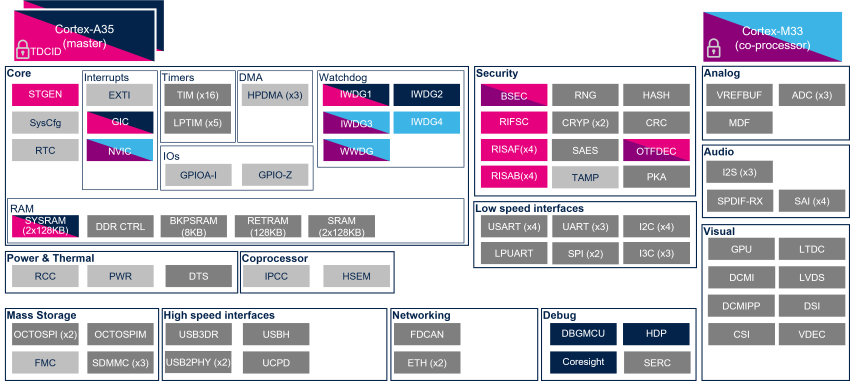
The figure below shows all peripherals embedded in STM32MP23x lines , grouped per functional domains that are reused in many places of this wiki to structure the articles.
Several execution contexts exist on STM32MP23x lines [1], corresponding to the different Arm cores and associated security modes:
- Arm dual core Cortex-A35 secure (Trustzone), running ROM code and TF-A BL2 at boot time, and running OP-TEE and/or TF-A BL31 at runtime
- Arm dual core Cortex-A35 non secure , running U-Boot at boot time, and running Linux at runtime
- Arm Cortex-M33 secure (Trustzone), running TF-M
- Arm Cortex-M33 non-secure , running STM32Cube
The legend below shows how assigned and shared peripherals are identified in the assignment diagram that follows:

- When a peripheral box owns execution context color, that means the assignment of this peripheral is fixed by hardware to the execution context.
- When a peripheral box owns a mix of two execution colors that means this peripheral is shared by hardware between the two execution contexts.
- When a peripheral box has dark gray color, that means this peripheral is protected by RIF and could be assigned to any execution context.
- When a peripheral box has light gray color, that means this peripheral is a RIF-aware peripheral. This peripheral owns several features which can be assigned independently to any execution context.
Internal peripheral assignment tables list assignment capabilities for each peripheral.
Both the diagram below and the following summary tables (in Internal peripherals runtime assignment and Internal peripherals boot time assignment chapters below) are clickable in order to jump to each peripheral overview articles and get more detailed information (like software frameworks used to control them). They list STMicroelectronics recommendations. The STM32MP23 reference manual [2] may expose more possibilities than what is shown here.
2. Internal peripherals boot time assignment[edit | edit source]
Click on  to expand or collapse the legend...
Check boxes illustrate the possible peripheral allocations supported by the OpenSTLinux BSP:
- ⬚ means that the peripheral can be assigned to the given boot time context, but this configuration is not supported in OpenSTLinux BSP.
- ☐ means that the peripheral can be assigned to the given boot time context.
- ☑ means that the peripheral is assigned by default to the given boot time context and that the peripheral is mandatory for the OpenSTLinux BSP.
- ✓ is used for system peripherals that cannot be unchecked because they are hardware connected in the device.
The present chapter describes STMicroelectronics recommendations or choice of implementation. Additional possibilities might be described in STM32 MPU reference manuals.
| Domain | Peripheral | Boot time allocation | Comment
| ||||
|---|---|---|---|---|---|---|---|
| Instance | Cortex-A35 secure (ROM code) |
Cortex-A35 secure (TF-A BL2) |
Cortex-A35 nonsecure (U-Boot) |
Cortex-M33 secure (MCUboot) | |||
| Core/Processors | Arm® Cortex®-A35 | Arm® Cortex®-A35 | ✓ | ✓ | ✓ | ⬚ | Can be started by MCUboot. Running the OpenSTLinux distribution. |
| Core/Processors | Arm® Cortex®-M33 | Arm® Cortex®-M33 | ✓ | ||||
| Analog | VREFBUF | VREFBUF | ⬚ | TF-M offers SCMI regulator service to manage VREFBUF | |||
| Analog | ADC | ADC12 | ⬚ | ☐ | ⬚ | ||
| ADC3 | ⬚ | ☐ | ⬚ | ||||
| Analog | MDF | MDF1 | ⬚ | ⬚ | ⬚ | ||
| Coprocessor | IPCC 
|
IPCC1 | Shareable at internal peripheral level thanks to the RIF: see the boot time allocation per feature | ||||
| Core | STGEN | STGEN | ✓ | ☑ | Read-only (STGENR) |
||
| Core | RTC
|
RTC | Shareable at internal peripheral level thanks to the RIF: see the boot time allocation per feature | ||||
| Core/DMA | HPDMA
|
HPDMAx (x = 1 to 3) | Shareable at internal peripheral level thanks to the RIF: see the boot time allocation per feature | ||||
| Core/DMA | LPDMA
|
LPDMA1 | Shareable at internal peripheral level thanks to the RIF: see the boot time allocation per feature | ||||
| Core/Interrupts | EXTI
|
EXTI1 | Shareable at internal peripheral level thanks to the RIF: see the boot time allocation per feature | ||||
| EXTI2 | Shareable at internal peripheral level thanks to the RIF: see the boot time allocation per feature | ||||||
| Core/IOs | GPIO
|
GPIOA-K | Shareable at internal peripheral level thanks to the RIF: see the boot time allocation per feature | ||||
| GPIOZ | Shareable at internal peripheral level thanks to the RIF: see the boot time allocation per feature | ||||||
| Core/RAM | SYSRAM | SYSRAM | ✓ | ✓ | |||
| Core/RAM | DDRCTRL & DDRPHYC | DDR | ✓ | Assignment is controlled by the RCC RIF 104 resource that also include the PLL2 control. | |||
| Core/RAM | SRAM | SRAM1 | ✓ | ☐ | ☐ | ☑ | Used during boot by MCUboot for his memory stack. |
| SRAM2 | ☐ | ☐ | ☑ | Used during boot by MCUboot to host DDR buffers used for DDR firmware installation | |||
| Core/Timers | TIM | TIMx (x = 1 to 8, 10 to 17) | ⬚ | ☐ | ⬚ | ||
| Core/Timers | LPTIM | LPTIMx (x = 1 to 5) | ⬚ | ⬚ | ⬚ | ||
| Core/Watchdog | IWDG | IWDG1 | ☐ | ☐ | ☐ | ||
| IWDG2 | ☐ | ⬚ | ☐ | ||||
| IWDG3 | ☐ | ||||||
| IWDG4 | ☐ | ||||||
| Core/Watchdog | WWDG | WWDG1 | ⬚ | ||||
| High speed interface | USB3DR | USB3DR | ⬚ | ☐ | ⬚ | The USB3DR can be used by U-Boot with command line tools. | |
| High speed interface | USBH | USBH | ⬚ | ☐ | ⬚ | ||
| High speed interface | UCPD | UCPD1 | ⬚ | ⬚ | ⬚ | ||
| High speed interface | USB2PHY | USB2PHY1 | ⬚ | ☐ | ⬚ | USB2PHY1 can be used in U-boot by USBH with command line tools. | |
| USB2PHY2 | ⬚ | ☐ | ⬚ | USB2PHY2 can be used in U-boot by USB3DR with command line tools. | |||
| Low speed interface | USART | UART4 | ☐ | ☐ | ☐ | ||
| UART5 | ☐ | ☐ | ☐ | ☐ | |||
| UART7 | ☐ | ☐ | ☐ | ||||
| USART1 | ☐ | ☐ | ☐ | ||||
| USART2 | ☐ | ☐ | ☐ | ☐ | |||
| USART3 | ☐ | ☐ | ☐ | ||||
| USART6 | ☐ | ☐ | ☐ | ☐ | |||
| Low speed interface | LPUART | LPUART1 | ⬚ | ⬚ | ⬚ | ||
| Low speed interface | I2C | I2C1 | ☐ | ☐ | ☐ | ||
| I2C2 | ☐ | ☐ | ☐ | ||||
| I2C7 | ☐ | ☐ | ☐ | ||||
| I2C8 | ☐ | ☐ | ☐ | ||||
| Low speed interface | I3C | I3C1 | ⬚ | ⬚ | ⬚ | ||
| I3C2 | ⬚ | ⬚ | ⬚ | ||||
| I3C4 | ⬚ | ⬚ | ⬚ | ||||
| Mass storage | OCTOSPI | OCTOSPI1 | ☐ | ☐ | ☐ | ☐ | |
| OCTOSPI2 | ☐ | ☐ | ☐ | ||||
| Mass storage | OCTOSPIM | OCTOSPIM | ☐ | ☐ | ☐ | ☐ | |
| Mass storage | FMC
|
FMC | Shareable at internal peripheral level thanks to the RIF: see the boot time allocation per feature | ||||
| Mass storage | SDMMC | SDMMC1 | ☐ | ☐ | ☐ | ☐ | |
| SDMMC2 | ☐ | ☐ | ☐ | ☐ | |||
| SDMMC3 | ☐ | ||||||
| Power & Thermal | RCC
|
RCC | Shareable at internal peripheral level thanks to the RIF: see the boot time allocation per feature For internal peripherals protected by a RISUP, the protection for reset and clock gating control is inherited from RIFSC configuration |
RCC peripheral is used by all boot components. More info here | |||
| Power & Thermal | PWR
|
PWR | Shareable at internal peripheral level thanks to the RIF: see the boot time allocation per feature |
||||
| Power & Thermal | DTS | DTS | ⬚ | ⬚ | ⬚ | ||
| Security | BSEC | BSEC | ✓ | ✓ | |||
| Security | RNG | RNG | ✓ | ☐ | ⬚ | ☑ | |
| Security | HASH | HASH | ✓ | ☐ | ☐ | ⬚ | |
| Security | CRYP | CRYP1 | ☑ | ⬚ | ⬚ | ⬚ | ROM code allocation is managed with the bit 8 in OTP 16 |
| CRYP2 | ⬚ | ⬚ | |||||
| Security | SAES | SAES | ☐ | ☐ | ⬚ | ⬚ | ROM code allocation is managed with the bit 8 in OTP 16 |
| Security | TAMP
|
TAMP | Shareable at internal peripheral level thanks to the RIF: see the boot time allocation per feature | ||||
| Security | OTFDEC | OTFDEC1 | ⬚ | ⬚ | ⬚ | ||
| OTFDEC2 | ⬚ | ⬚ | ⬚ | ||||
| Security | PKA | PKA | ✓ | ☐ | ⬚ | ⬚ | |
| Security | RIFSC | RIFSC | ✓ | ☑ | ☑ | ☑ | |
| Security | RISAB | RISAB1 | ✓ | ✓ | ⬚ | ||
| RISAB2 | ✓ | ✓ | ⬚ | ||||
| RISAB3 | ✓ | ⬚ | ⬚ | Used by ROM code only in serial boot for USB buffer management | |||
| RISAB4 | ⬚ | ⬚ | ☑ | Used by MCUBoot for the DDR firmware buffer | |||
| RISAB5 | ✓ | ⬚ | ⬚ | Used by ROM code only during cold boot | |||
| RISAB6 | ⬚ | ⬚ | |||||
| Security | RISAF | RISAF1 | ☐ | ⬚ | ☐ | ||
| RISAF2 | ☐ | ⬚ | ☐ | ||||
| RISAF4 | ☐ | ⬚ | ☑ | FSBL MCUboot configures Cortex-M secure and encrypted memory regions | |||
| Security | IAC | IAC | ⬚ | Fixed to TDCID | |||
| Trace & debug | SERC | SERC | ⬚ | ⬚ | ⬚ | ||
| Visual | DSI
|
DSI | Shareable at internal peripheral level thanks to the RIF: see the boot time allocation per feature | ||||
| Visual | LTDC | LTDC_CMN | ☐ | ||||
| LTDC_L1L2 | ☐ | ||||||
| LTDC_L3 | ⬚ | ||||||
| LTDC_ROT | ⬚ | ||||||
| Visual | LVDS | LVDS | ☐ | ||||
3. Internal peripherals runtime assignment[edit | edit source]
Click on to expand or collapse the legend...

Check boxes illustrate the possible peripheral allocations supported by the OpenSTLinux BSP:
- ⬚ means that the peripheral can be assigned to the given runtime context, but this configuration is not supported in OpenSTLinux BSP.
- ☐ means that the peripheral can be assigned to the given runtime context.
- ☑ means that the peripheral is assigned by default to the given runtime context and that the peripheral is mandatory for the OpenSTLinux BSP.
- ✓ is used for system peripherals that cannot be unchecked because they are hardware connected in the device.
Refer to How to assign an internal peripheral to an execution context for more information on how to assign peripherals manually or via STM32CubeMX.
The present chapter describes STMicroelectronics recommendations or choice of implementation. Additional possibilities might be described in STM32MP23 reference manuals.
| Domain | Peripheral | Runtime allocation | Comment
| ||||
|---|---|---|---|---|---|---|---|
| Instance | Cortex-A35 secure (OP-TEE / TF-A BL31) |
Cortex-A35 nonsecure (Linux) |
Cortex-M33 secure (TF-M) |
Cortex-M33 nonsecure (STM32Cube) | |||
| Core/Processors | Arm® Cortex®-A35 | Arm® Cortex®-A35 | ✓OP-TEE ✓TF-A BL31 |
✓ | ☐ | ⬚ | In M33-TD flavor , Cortex-A35 can be started by TF-M or by STM32CubeMP2. Running the OpenSTLinux distribution. |
| Core/Processors | Arm® Cortex®-M33 | Arm® Cortex®-M33 | ✓ | ☐ | |||
| Analog | ADC | ADC12 | ☐OP-TEE | ☐ | ⬚ | ☐ | |
| ADC3 | ☐OP-TEE | ☐ | ⬚ | ☐ | |||
| Analog | MDF | MDF1 | ⬚OP-TEE | ☐ | ⬚ | ☐ | |
| Audio | SPDIFRX | SPDIFRX | ⬚OP-TEE | ☐ | ⬚ | ☐ | |
| Audio | SAI | SAI1 | ⬚OP-TEE | ☐ | ⬚ | ☐ | |
| SAI2 | ⬚OP-TEE | ☐ | ⬚ | ☐ | |||
| SAI3 | ⬚OP-TEE | ☐ | ⬚ | ☐ | |||
| SAI4 | ⬚OP-TEE | ☐ | ⬚ | ☐ | |||
| Coprocessor | IPCC
|
IPCC1 | Shareable at internal peripheral level thanks to the RIF: see the runtime allocation per feature | ||||
| Core | STGEN | STGEN | ☑OP-TEE ☑TF-A BL31 |
Read-only (STGENR) |
|||
| Core | RTC
|
RTC | Shareable at internal peripheral level thanks to the RIF: see the runtime allocation per feature | RTC is mandatory to resynchronize STGEN after exiting low-power modes. | |||
| Core/DMA | HPDMA
|
HPDMAx (x = 1 to 3) | Shareable at internal peripheral level thanks to the RIF: see the runtime allocation per feature | ||||
| Core/DMA | LPDMA
|
LPDMA | Shareable at internal peripheral level thanks to the RIF: see the runtime allocation per feature | ||||
| Core/Interrupts | EXTI
|
EXTI1 | Shareable at internal peripheral level thanks to the RIF: see the runtime allocation per feature | ||||
| EXTI2 | Shareable at internal peripheral level thanks to the RIF: see the runtime allocation per feature | ||||||
| Core/IOs | GPIO
|
GPIOA-K | Shareable at internal peripheral level thanks to the RIF: see the runtime allocation per feature | ||||
| GPIOZ | Shareable at internal peripheral level thanks to the RIF: see the runtime allocation per feature | ||||||
| Core/RAM | SYSRAM | SYSRAM | ☑BL31 ☐OP-TEE |
☑ | ☐ | ☐ |
Cortex-A35 secure section required for low power entry and exit |
| Core/RAM | DDRCTRL & DDRPHYC | DDR | ✓ | ⬚ | Assignment is controlled by the RCC RIF 104 resource that also include the PLL2 control. | ||
| Core/RAM | BKPSRAM | BKPSRAM | ☑BL31 ⬚OP-TEE |
⬚ | ☑ | ⬚ |
Assignment thanks to RISAF1 |
| Core/RAM | RETRAM | RETRAM | ☑BL31 ⬚OP-TEE |
⬚ | ⬚A35-TD flavor
☑M33-TD flavor |
⬚ |
Assignment thanks to RISAB5 |
| Core/RAM | SRAM | SRAM1 | ☑OP-TEE
☐BL31 |
☑ | ☑ | ☐ | BSEC mirror, SCMI CID1 exchange area, PSA buffer. |
| SRAM2 | ☐OP-TEE ☐BL31 |
☐ | ☐ | ☐ | |||
| Core/Timers | TIM | TIMx (x = 1 to 8, 10 to 17) | ⬚OP-TEE | ☐ | ⬚ | ☐ | |
| Core/Timers | LPTIM | LPTIM1 | ☐OP-TEE | ☐ | ⬚ | ☐ | LPTIM1 can be used for HSE monitoring. |
| LPTIM2 | ☐OP-TEE | ☐ | ⬚ | ☐ | |||
| LPTIM3 | ☐OP-TEE | ☐ | ⬚ | ☐ | LPTIMy (y = 3, 4, 5) can be used for scheduling in low power modes by Linux | ||
| LPTIM4 | ☐OP-TEE | ☐ | ⬚ | ☐ | LPTIMy (y = 3, 4, 5) can be used for scheduling in low power modes by Linux | ||
| LPTIM5 | ☐OP-TEE | ☐ | ⬚ | ☐ | LPTIMy (y = 3, 4, 5) can be used for scheduling in low power modes by Linux | ||
| Core/Watchdog | IWDG | IWDG1 | ☐OP-TEE ☐TF-A BL31 |
☐ | |||
| IWDG2 | ☐OP-TEE ☐TF-A BL31 |
☐ | |||||
| IWDG3 | ☐ | ☐ | |||||
| IWDG4 | ☐ | ☐ | |||||
| Core/Watchdog | WWDG | WWDG1 | ⬚ | ☐ | |||
| High speed interface | USB3DR | USB3DR | ⬚OP-TEE | ☐ | ⬚ | ⬚ | The USB3DR running at USB2 speed. |
| High speed interface | USBH | USBH | ⬚OP-TEE | ☐ | ⬚ | ⬚ | |
| High speed interface | UCPD | UCPD1 | ⬚OP-TEE | ⬚ | ⬚ | ☐ | |
| High speed interface | USB2PHY | USB2PHY1 | ⬚OP-TEE ⬚TF-A BL31 |
☐ | ⬚ | ☐ | Allocation inherited from USBH |
| USB2PHY2 | ⬚OP-TEE ☐TF-A BL31 |
☐ | ⬚ | ☐ | Allocation inherited from USB3DR | ||
| Low speed interface | USART | UART4 | ☐OP-TEE ☐TF-A BL31 |
☐ | ☐ | ☐ | |
| UART5 | ☐OP-TEE ☐TF-A BL31 |
☐ | ☐ | ☐ | |||
| UART7 | ☐OP-TEE ☐TF-A BL31 |
☐ | ☐ | ☐ | |||
| USART1 | ☐OP-TEE ☐TF-A BL31 |
☐ | ☐ | ☐ | |||
| USART2 | ☐OP-TEE ☐TF-A BL31 |
☐ | ☐ | ☐ | |||
| USART3 | ☐OP-TEE ☐TF-A BL31 |
☐ | ☐ | ☐ | |||
| USART6 | ☐OP-TEE ☐TF-A BL31 |
☐ | ☐ | ☐ | |||
| Low speed interface | LPUART | LPUART1 | ⬚OP-TEE ⬚TF-A BL31 |
☐ | ⬚ | ☐ | |
| Low speed interface | I2C | I2C1 | ☐OP-TEE ⬚TF-A BL31 |
☐ | ☐ | ☐ | |
| I2C2 | ☐OP-TEE ⬚TF-A BL31 |
☐ | ☐ | ☐ | |||
| I2C7 | ☐OP-TEE ⬚TF-A BL31 |
☐ | ☐ | ☐ | Used for PMIC control on ST boards. | ||
| I2C8 | ☐OP-TEE ⬚TF-A BL31 |
☐ | ☐ | ☐ | |||
| Low speed interface | I3C | I3C1 | ⬚OP-TEE ⬚TF-A BL31 |
☐ | ⬚ | ☐ | |
| I3C2 | ⬚OP-TEE ⬚TF-A BL31 |
☐ | ⬚ | ☐ | |||
| I3C4 | ⬚OP-TEE ⬚TF-A BL31 |
☐ | ⬚ | ☐ | |||
| Mass storage | OCTOSPI | OCTOSPI1 | ⬚OP-TEE | ☐ | ☐ | ☐ | OP-TEE need to access OCTOSPI1 at boot time to set OSPIM mode |
| OCTOSPI2 | ⬚OP-TEE | ☐ | ☐ | ☐ | OP-TEE need to access OCTOSPI2 at boot time to set OSPIM mode | ||
| Mass storage | OCTOSPIM | OCTOSPIM | ☐OP-TEE | ☐ | ☐ | ☐ | |
| Mass storage | FMC
|
FMC | Shareable at internal peripheral level thanks to the RIF: see the runtime allocation per feature | ||||
| Mass storage | SDMMC | SDMMC1 | ⬚OP-TEE | ☐ | ☐ | ☐ | |
| SDMMC2 | ⬚OP-TEE | ☐ | ☐ | ☐ | |||
| SDMMC3 | ⬚OP-TEE | ☐ | ☐ | ☐ | |||
| Power & Thermal | RCC
|
RCC | Shareable at internal peripheral level thanks to the RIF: see the runtime allocation per feature. For internal peripherals protected by a RISUP, the protection for reset and clock gating control is inherited from RIFSC configuration. |
RCC peripheral is used by all software components. More info here. The Cortex-M secure OS TF-M controls the system resources and provides SCMI services | |||
| Power & Thermal | PWR
|
PWR | Shareable at internal peripheral level thanks to the RIF: see the runtime allocation per feature |
||||
| Power & Thermal | DTS | DTS | ⬚TF-A BL31 ⬚OP-TEE |
☐ | ⬚ | ⬚ | |
| Security | BSEC | BSEC | ✓ | ||||
| Security | RNG | RNG | ☐OP-TEE | ⬚ | ☐ | ⬚ | |
| Security | HASH | HASH | ☐OP-TEE | ☐ | ⬚ | ☐ | |
| Security | CRYP | CRYP1 | ☐OP-TEE | ☐ | ⬚ | ☐ | |
| CRYP2 | ☐OP-TEE | ☐ | ⬚ | ☐ | |||
| Security | CRC | CRC | ⬚OP-TEE | ☐ | ⬚ | ☐ | |
| Security | SAES | SAES | ☐OP-TEE | ⬚ | ☑ | ⬚ | |
| Security | TAMP
|
TAMP | Shareable at internal peripheral level thanks to the RIF: see the runtime allocation per feature | ||||
| Security | OTFDEC | OTFDEC1 | ⬚OP-TEE | ⬚ | ⬚ | ⬚ | |
| OTFDEC2 | ⬚OP-TEE | ⬚ | ⬚ | ⬚ | |||
| Security | RIFSC | RIFSC | ☑OP-TEE | ☑ | ☑ | ☐ | |
| Security | RISAB | RISAB1 | ☑OP-TEE | ⬚ | |||
| RISAB2 | ☑OP-TEE | ⬚ | |||||
| RISAB3 | ☐OP-TEE | ⬚ | ☑ | ⬚ | |||
| RISAB4 | ☐OP-TEE | ⬚ | ☑ | ⬚ | |||
| RISAB5 | ☐OP-TEE | ⬚ | ☑ | ⬚ | |||
| RISAB6 | ☐OP-TEE | ⬚ | ☑ | ⬚ | |||
| Security | RISAF | RISAF1 | ☐OP-TEE | ⬚ | ☑ | ⬚ | TF-M configures all regions |
| RISAF2 | ☐OP-TEE | ⬚ | ☑ | ⬚ | TF-M configures all regions | ||
| RISAF4 | ☐OP-TEE | ⬚ | ☑ | ⬚ | TF-M configures all regions all regions except its own | ||
| Security | IAC | IAC | ✓ | Fixed to TDCID | |||
| Trace & debug | SERC | SERC | ☐OP-TEE | ⬚ | ☑ | ⬚ | Assignment (single choice) |
| Trace & Debug | HDP | HDP | ⬚OP-TEE | ☐ | ⬚ | ⬚ | |
| Visual | GPU | GPU | ⬚OP-TEE | ☐ | ⬚ | ⬚ | |
| Visual | DSI
|
DSI | Shareable at internal peripheral level thanks to the RIF: see the runtime allocation per feature | ||||
| Visual | LTDC | LTDC_CMN | ⬚OP-TEE | ☐ | ⬚ | ☐ | |
| LTDC_L1L2 | ⬚OP-TEE | ☐ | ⬚ | ☐ | |||
| LTDC_L3 | ☐OP-TEE | ☐ | ⬚ | ☐ | |||
| LTDC_ROT | ⬚OP-TEE | ☐ | ⬚ | ☐ | |||
| Visual | DCMI | DCMI | ⬚OP-TEE | ☐ | ⬚ | ☐ | |
| Visual | CSI | CSI | ⬚OP-TEE | ☐ | ⬚ | ☐ | |
| Visual | LVDS | LVDS | ⬚OP-TEE | ☐ | ⬚ | ☐ | |
| Visual | DCMIPP | DCMIPP | ⬚OP-TEE | ☐ | ⬚ | ☐ | |
| Visual | VDEC | VDEC | ⬚OP-TEE | ☐ | ⬚ | ⬚ | |
4. References[edit | edit source]
Arm® is a registered trademark of Arm Limited (or its subsidiaries) in the US and/or elsewhere. 
Arm® is a registered trademark of Arm Limited (or its subsidiaries) in the US and/or elsewhere.